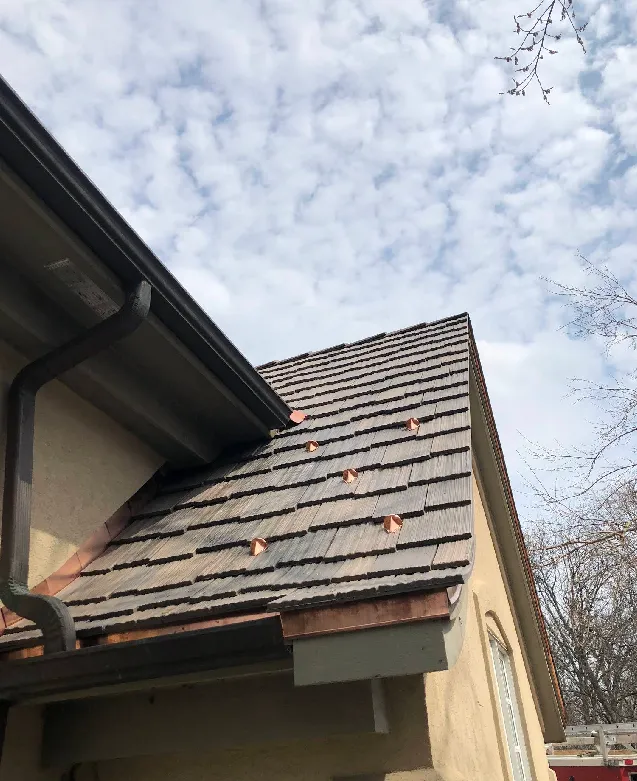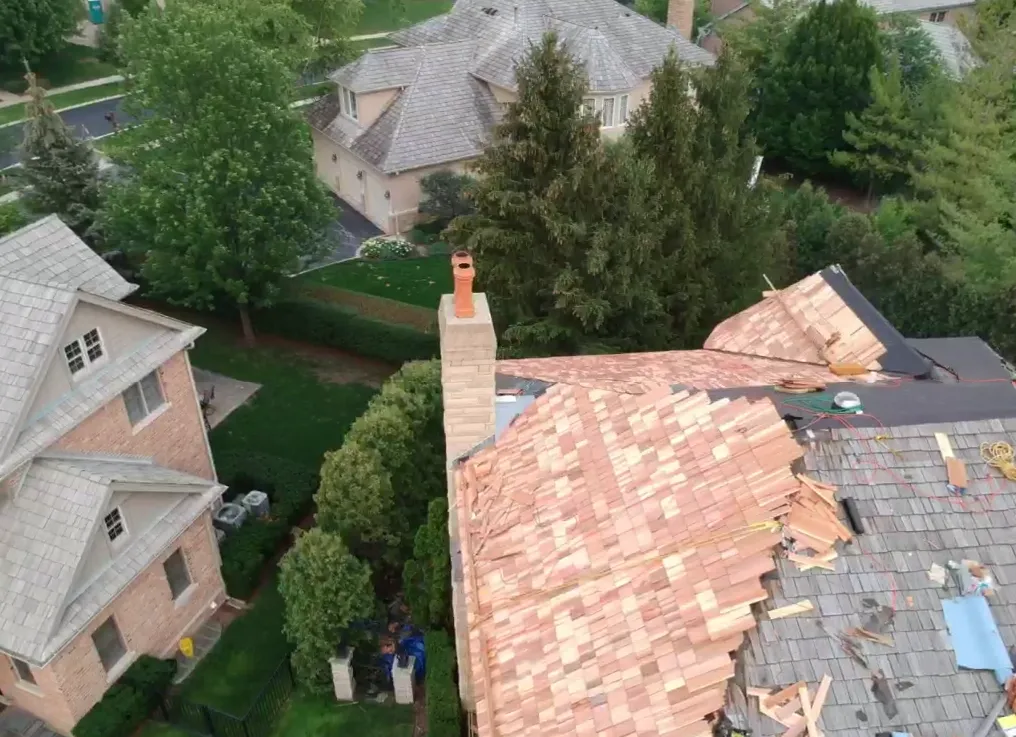
Every cedar roof in the Chicago area changes color. A roof that was warm reddish-amber the year it was installed is silver-gray by its third or fourth summer, and homeowners who call us about it are usually convinced something has gone wrong. In most cases, nothing has. What they are looking at is the single most misunderstood characteristic of wood roofing: cedar looks worse long before it performs worse.
The problem is that the opposite is also true. Cedar can be actively decaying underneath a surface that still looks acceptable from the driveway, and by the time the damage is visible from the ground, it has usually reached the sheathing. Color tells you almost nothing. Hardness tells you almost everything.
This article explains the difference in technical terms, gives you the specific tests that separate the two conditions, and identifies the places on a cedar roof where decay reliably begins — including the one location almost no homeowner ever inspects.
The Short Answer: Color Is Not the Test
Weathering is a surface phenomenon. It is a photochemical and mechanical change to the outermost layer of the wood, and on unfinished softwood the affected depth is measured in fractions of a millimeter. The wood underneath is unchanged in strength.
Rot is a structural phenomenon. It is biological consumption of the wood’s cellulose and lignin by fungi, and it removes material — permanently. A rotted shake is not a discolored shake. It is a lighter, weaker, softer shake with less wood in it than it had before.
So the diagnostic question is never “what color is my roof?” It is:
- Is the wood still hard?
- Does it still resist a probe?
- Does it break with fiber, or crumble into pieces?
- Is it still drying out between rain events?
Everything below is an expansion of those four questions.
What Weathering Actually Is
The UV Reaction
Wood is roughly 40–50% cellulose, 20–30% hemicellulose, and 20–30% lignin. Lignin is the compound that binds the cellulose fibers together, and it is the component that absorbs ultraviolet light most readily.
When UV radiation hits an exposed cedar surface, it degrades the lignin in the top layer. The freed cellulose fibers scatter light differently than intact wood, which is what produces the familiar silver-gray appearance. Rain then washes away the degraded lignin and the water-soluble extractives that give western red cedar its reddish tone.
The critical detail is depth. UV photodegradation typically penetrates only about 0.05 to 0.1 mm into the wood surface — thinner than a sheet of paper. Below that layer, the shake is chemically and mechanically the same wood it was on installation day.
Surface erosion — the slow loss of those degraded fibers to wind and rain — proceeds at roughly a quarter of an inch per century on exposed softwood. On a medium hand-split shake at 1/2 inch thickness, or a heavy shake at 3/4 inch, erosion alone will never be the reason the roof fails. Something else always gets there first.
Why Some Slopes Gray Faster Than Others
Uneven graying is one of the most common triggers for a worried phone call, and it is almost always normal exposure variation rather than a defect:
- South and west slopes receive the most direct UV and gray fastest, often reaching full silver within two to three years.
- North slopes gray more slowly but hold moisture longer, which means they develop mildew and algae staining sooner. The result is a north slope that looks darker and blotchier than the crisp gray south slope on the same house.
- Sheltered areas under deep eaves, dormer walls, or a mature tree canopy may keep their original brown tone for years while the surrounding field has fully weathered.
A roof with three different tones on three different planes is behaving exactly as wood roofing behaves. A roof with isolated dark patches in the middle of an otherwise uniform plane is a different story, and that is covered further down.
Checking: The Cracks That Are Supposed to Be There
Cedar shakes gain and lose moisture with every wetting and drying cycle, and wood moves anisotropically — it expands and contracts far more across the grain than along it. That differential produces checking: fine cracks that run parallel to the grain, along the length of the shake.
Checking is normal. On a mature cedar roof it is universal. What matters is:
- Direction. Checks follow the grain. Cracks running across the grain are a warning sign, discussed below.
- Depth. Surface checks that do not pass through the full thickness of the shake are cosmetic. A shake split cleanly through its thickness has lost its ability to shed water and should be replaced individually.
- Width. A check you can slide a fingernail into is still a check. A gap you can see daylight through, on a roof laid with proper triple coverage, means the courses below are now doing work they were not designed to do alone.
Normal Cupping and Lift
Every cedar shake curls slightly at its butt end over time as the exposed portion dries faster than the covered portion. Mild, uniform cupping across a whole slope is ordinary aging and does not compromise performance, because a correctly installed cedar roof relies on overlap rather than a perfect seal.
Severe curling — shakes lifting far enough to catch wind, expose the keyway below, or admit driven rain — is a different condition. It usually indicates either a moisture problem beneath the roof or an installation that never allowed the shakes to dry from both sides. That distinction matters more than any other single factor in cedar roof longevity, and we return to it below.
What Rot Actually Is
The Moisture Threshold That Changes Everything
Wood does not rot because it gets wet. Wood rots because it stays wet.
Wood-destroying fungi require four conditions simultaneously: a food source (the wood), oxygen, a temperature roughly between 40°F and 100°F, and free water inside the wood cells. That last requirement is the one you can control, and it has a number attached to it.
Below approximately 20% moisture content, decay fungi cannot establish or sustain growth. The fiber saturation point of wood — where cell walls are saturated and free water begins to occupy the cell cavities — sits around 28–30%. Between 20% and 30% MC, fungi become progressively more active. Above 30%, in the right temperature range, decay proceeds efficiently.
A cedar roof in the Chicago climate gets soaked dozens of times a year. That is fine, and cedar is chosen precisely because it handles it. What is not fine is a roof that cannot get back below 20% before the next wetting event. Every design and maintenance decision that matters on a cedar roof — ventilation beneath the shakes, keeping the surface clear of moss and debris, trimming back overhanging limbs, correct spacing between shakes — exists to protect that single threshold.
Why Cedar Resists Decay, and Why That Protection Expires
Western red cedar heartwood contains natural extractives, primarily thujaplicins, that are genuinely fungicidal. This is not marketing; it is the reason cedar has been used as a roofing material for centuries without chemical treatment.
But those extractives are finite and water-soluble. Decades of rain progressively leach them out of the exposed surface layers. A twenty-five-year-old cedar roof has substantially less natural fungicide in its outer wood than it did when new, which is why decay problems in cedar roofs are so heavily concentrated in the back half of the roof’s service life. It is also why preservative treatment on a mid-life cedar roof is far more valuable than most homeowners assume — it replaces protection the wood has already lost.
Two further points are worth knowing:
- Sapwood is not durable. Only heartwood carries meaningful extractive content. Lower shake grades permit more sapwood, flat grain, and edge defects, which is a large part of why grade selection drives lifespan.
- Extractives do not protect against moss. They inhibit fungal decay, not the bryophytes and algae that hold water on the surface and create the conditions decay fungi need.
For a fuller picture of how these factors combine over decades, see our breakdown of cedar roof life expectancy.
Brown Rot, White Rot, and Soft Rot
The three decay types you encounter on a wood roof present differently, and recognizing which one you are looking at tells you how far the problem has progressed.
Brown rot consumes cellulose and hemicellulose while leaving lignin behind. The wood turns dark brown, shrinks, and develops a characteristic cross-grain cracking pattern that breaks the surface into cube-like blocks. It crumbles to powder under pressure. Brown rot is the most structurally destructive type and is the one most often found in roof sheathing and framing.
White rot breaks down both cellulose and lignin. Affected wood turns pale, bleached, and yellowish-white, loses its distinct grain pattern, and takes on a stringy or fibrous texture rather than a blocky one.
Soft rot works slowly on wood surfaces that are wet for long periods, producing a thin softened layer that can be scraped away with a fingernail while the wood beneath is still sound. On cedar roofs this is common on the constantly damp lower courses and on north-facing slopes under tree cover, and it is the type most frequently mistaken for weathering.
Weathering vs. Rot: Side by Side
| Indicator | Normal weathering | Active decay |
| Color | Uniform silver-gray across a plane; tonal differences by exposure | Isolated dark brown, blackish, or bleached-white patches within an otherwise uniform plane |
| Surface hardness | Firm; thumbnail leaves a mark but does not sink in | Thumbnail or fingernail sinks into the surface; fibers lift away |
| Probe resistance | Screwdriver tip penetrates barely, with resistance | Screwdriver penetrates 1/4 inch or more under light hand pressure |
| Cracking direction | Fine checks parallel to the grain | Cracking across the grain; blocky, cube-like fracture pattern |
| Break behavior | Snaps with a distinct crack and fibrous, splintery edges | Crumbles, powders, or pulls apart with almost no resistance |
| Sound when tapped | Solid, ringing | Dull, hollow thud |
| Weight and feel | Dense and light-colored inside | Noticeably lighter; punky or spongy; sometimes damp days after rain |
| Depth affected | Fractions of a millimeter | Full thickness of the shake; often the sheathing beneath as well |
| Drying behavior | Dry to the touch within a day or two of rain | Still damp after several dry days |
| Odor | None, or faint cedar | Musty, earthy, mushroom-like — especially noticeable in the attic |
| What it means | Cosmetic. No action required beyond routine maintenance | Progressive. Spreads to adjacent shakes and to the deck below |
Six Tests You Can Do Without Getting on the Roof
Cedar shakes are slippery when damp, and a slope with existing decay is genuinely unsafe to walk because the sheathing beneath may not hold weight. Every test below can be done from the ground, a ladder at the eave, or inside the attic.
1. The Thumbnail Test
At the eave or on an accessible garage or dormer slope, press your thumbnail firmly into the butt end of a shake. Weathered cedar resists — you will leave a mark, not a hole. If your nail sinks in, or the surface fibers separate and lift away, you are feeling softened wood. That is either soft rot or the beginning of it.
2. The Screwdriver Probe
The standard field test for wood decay. Press a flathead screwdriver into the wood using moderate hand pressure — not hammering, not levering. Sound cedar stops the tip almost immediately. Penetration of about 1/4 inch or more indicates decay, and penetration that continues until the tip stops on nothing means the shake has lost most of its structure.
Do this at the butt ends of the lowest course, around any visible dark staining, and — importantly — on the exposed sheathing edge visible from under the eave.
3. The Break Test
If a shake has come loose or blown off, break it in half. This is the most reliable single test available to a homeowner.
Weathered cedar snaps. You hear it, and the broken faces are splintery and fibrous. Decayed cedar does not snap; it separates, crumbles, or comes apart in blocks with a texture closer to dry cake than wood. Compare the broken face against a fresh cedar shake if you can get hold of one — the difference in fiber structure is unmistakable.
4. The Gutter Test
Clean out a section of gutter and look at what comes out.
Fine grit and small cedar fibers are the product of normal surface erosion and appear in the gutters of every healthy cedar roof. What should concern you is volume and particle size: significant quantities of soft, punky fibrous material, or fragments that crumble between your fingers, indicate that shakes are shedding structure rather than surface.
5. The Attic Inspection
This is the highest-value fifteen minutes you can spend, and the test most homeowners skip. Go into the attic on a bright day with a strong flashlight and no other lights on. Look for:
- Daylight visible through the roof deck at any point other than intentional vents.
- Dark staining or tide lines on the underside of the sheathing, particularly near valleys, chimneys, skylights, and the eaves.
- Mold growth on rafters or sheathing — typically black, gray, or white patches.
- Soft or spongy sheathing. Probe the underside of the boards with a screwdriver. The deck should be firm everywhere.
- A musty smell. Fungal decay has a distinct earthy, mushroom-like odor, and in an enclosed attic it is often detectable before anything is visible.
- Compressed or damp insulation, which indicates water has been arriving for some time.
6. The Moisture Meter Check
A pin-type moisture meter costs less than a decent hand tool and settles the question directly. Take readings on accessible shake butts and on the sheathing from inside the attic, and take them at least three or four dry days after the last rain.
Readings consistently at or above 20% under those conditions mean the wood is not drying out. It does not prove decay has started, but it proves the condition that causes decay is present, which is actionable information either way.
Where Rot Starts on a Cedar Roof
Decay is not random. It begins in predictable locations, most of which are difficult or impossible to see from the ground.
The Covered Portion of the Shake
An 18-inch shake is typically laid at 7.5 inches of exposure, and a 24-inch shake at 10 inches. That means well over half the length of every shake on your roof is permanently hidden beneath the course above it.
That covered zone is where decay usually starts. It is shaded, it dries slowly, and it sits directly against the shake below. When you inspect the visible field of a cedar roof, you are looking at the part of each shake most likely to still be sound — and drawing conclusions about the part you cannot see.
The Keyways and the Lower Courses
Water concentrates in the gaps between adjacent shakes and travels down the roof, so the bottom courses handle more total water than anything above them. Combine that with gutters that hold debris, ice that accumulates at the eave, and splashback, and the first two or three courses above the gutter line are the single most common starting point for cedar roof decay.
North Slopes and Tree Cover
North-facing slopes receive the least solar drying and stay damp the longest. Add a mature canopy overhead and the situation compounds: shade extends drying time further, and falling needles, leaves, and seed pods accumulate in the keyways, where they hold moisture directly against the wood and feed moss growth.
This is a defining problem for cedar roofs in the older, heavily wooded North Shore communities. The oak and elm canopy that makes Winnetka, Glencoe, and Lake Forest architecturally distinctive is also the reason cedar roofs there frequently show decay on north and east slopes while the south slope remains in serviceable condition.
Valleys, Chimneys, Skylights, and Flashing Lines
Anywhere two roof planes meet or a penetration interrupts the field, water volume increases and the shakes depend on metal flashing rather than overlap alone. Failed or undersized flashing produces localized decay long before the surrounding field shows any deterioration.
This is also where the choice of metal matters. Galvanized flashing corrodes; the runoff from it can stain and degrade adjacent wood. Copper and zinc flashing outlast the roof itself, and zinc runoff has the useful side effect of suppressing moss growth on the courses immediately below.
The Underside: The Failure Nobody Inspects
A cedar shake must be able to dry from both faces. This is not a preference, it is a requirement of the material.
When cedar is installed directly over solid decking and underlayment with no ventilating layer between, the underside of every shake sits against a surface that does not breathe. Moisture that migrates in from below — or that enters through a keyway and cannot escape — keeps the back of the shake above the 20% threshold indefinitely. The roof then decays from the inside out, and the top surface can look entirely acceptable while the hidden face is failing.
Historically, cedar was laid over spaced or “skip” sheathing precisely to allow that airflow. Modern construction favors solid decking, which is why a ventilating mat such as Cedar Breather is installed between the underlayment and the shakes: it creates a continuous air space so both faces of the wood can dry. When a cedar roof fails well short of its expected service life and the shakes themselves were good grade material, inadequate under-shake ventilation is the most likely explanation. You can see how we detail this on our own installations in the project gallery.
The Sheathing Below
Once decay reaches the deck, the problem stops being a roofing question and becomes a structural one. Soft sheathing cannot hold fasteners, will not support a person’s weight, and cannot be covered over — it has to be replaced before any new roof goes down. This is the difference between a repair scoped in shakes and a project scoped in framing, which is why the attic inspection above is worth doing before you get an estimate rather than after.
Why Chicago-Area Cedar Roofs Reach the Threshold Faster
National figures for cedar roof lifespan assume an average climate. The Chicago and North Shore climate is not average for wood.
Freeze-thaw cycling. The Chicago area passes through the freezing point dozens of times each winter. Water that has entered a check in a shake expands when it freezes, widening the check; the wider check then admits more water, which freezes again. This cycle mechanically opens the pathways that let moisture reach the interior of the wood and the sheathing behind it. Weathering checks that would remain cosmetic in a milder climate progressively become water entry points here.
Ice dams. Snow melts over a warm attic, runs to the cold eave, refreezes, and forms a dam that holds standing meltwater on the lowest courses of the roof — the same courses that are already the most vulnerable. A cedar roof under an ice dam is not shedding water; it is soaking in it, for weeks. Ice dams are the fastest way to convert a healthy lower course into a decayed one, and they are a symptom of attic ventilation and insulation problems rather than of the roof covering itself.
Humidity and lake effect. Summer humidity in the region regularly sits high enough to slow evaporative drying substantially, and proximity to Lake Michigan extends the periods when surfaces stay damp. Drying windows are shorter here than the material’s design assumptions imply.
Spring and fall debris load. Two heavy debris seasons per year, in a region with mature tree cover, means keyways fill with organic material twice annually. Left in place, that material is a moisture reservoir sitting in direct contact with the wood.
None of this makes cedar a poor choice for the region — cedar roofs in these communities routinely last decades. It does mean that the maintenance interval that keeps a cedar roof healthy here is shorter than the interval a general manufacturer’s guideline suggests.
Three Conditions That Get Misdiagnosed
Moss Is Not Rot, But It Causes It
Green moss on a cedar roof is not decay and does not consume the wood. What it does is far more consequential: it holds water against the surface continuously, keeps the underlying wood above the 20% moisture threshold, and its root-like structures work into checks and keyways, widening them.
Moss is best understood as a decay incubator. On its own it is a cosmetic problem; left for several seasons on a north slope, it reliably produces the real thing underneath. Removing it is worthwhile — but pressure washing a cedar roof to do it strips surface fibers, drives water up under the courses, and shortens the roof’s life significantly. Moss on cedar requires low-pressure treatment, not force.
Black Streaking Is Usually Surface Mildew
Dark streaks and blotches on cedar are most often mildew and algae growing on the surface, not fungal decay inside the wood. The distinguishing test is the thumbnail: mildew sits on top of hard wood, decay softens the wood itself. Mildew is a maintenance item and an indicator that the area stays damp longer than it should. It is not, by itself, a reason to replace anything.
Dark, Wet-Looking Shakes Right After Rain
Wet cedar looks alarming. It darkens dramatically, and a roof that appears healthy on a dry Tuesday can look like it is failing on a wet Wednesday. Judge a cedar roof three to four dry days after rain. Areas that are still dark and still damp at that point are the ones worth investigating; areas that have returned to uniform gray are doing their job.
Why the Diagnosis Determines the Scope of the Work
Getting this distinction right, early, is the difference between three categories of project.
Weathering only. No structural work is warranted. The appropriate response is maintenance: clearing debris from keyways and valleys, treating for moss and mildew, replacing individual split or missing shakes, and applying a preservative treatment to restore the fungicidal protection the wood has leached out over the years. This is the least expensive path available on a cedar roof, and it is only available while the wood is still sound.
Localized decay. Confined to identifiable areas — the lower courses, one north slope, the shakes around a chimney — with sound sheathing beneath. This is repair territory: affected shakes are replaced, the underlying cause is corrected (flashing, ventilation, drainage, tree clearance), and the balance of the roof is treated and maintained. A cedar roof caught at this stage often has a great deal of service life left.
Widespread decay with deck involvement. Once softening extends across multiple slopes and the sheathing has been compromised, partial repair stops being economical. Replacing shakes over a deteriorated deck produces a roof that fails again on the same timeline, because the moisture condition that caused the decay is still in place. At this stage the correct answer is full replacement with the ventilation, fastening, and flashing details corrected — stainless steel fasteners that will not corrode inside wet wood, a ventilating layer beneath the shakes, and flashing metal that outlasts the roof.
The cost difference between these three paths is not incremental. It is the reason a cedar roof deserves an actual inspection at intervals, rather than a glance from the driveway once a decade.
Get a Straight Answer About Your Roof
If your cedar roof has gone gray, that is almost certainly nothing to fix. If it has gone soft, waiting a season makes it materially worse — decay does not pause, and it moves toward the deck.
All Roofs Cedar Shake works exclusively on cedar and shake roofing across Chicago and the surrounding suburbs, including Winnetka, Wilmette, Glencoe, Highland Park, Northbrook, Glenview, Lake Forest, Barrington, Hinsdale, Oak Park, and Naperville. We assess the shakes, probe the sheathing, check the ventilation beneath the roof, and tell you which of the three categories above you are actually in — including when the answer is “your roof is fine, leave it alone.”
Call (224) 432-6887 or request a free inspection online. Licensed cedar roofing specialists, Roofing License 104.031891, based at 874 Green Bay Rd, Winnetka, IL.
Frequently Asked Questions
Is it normal for a cedar roof to turn gray? Yes. Graying is UV degradation of lignin in the outermost layer of the wood, typically less than 0.1 mm deep. It affects appearance only and has no bearing on the strength or performance of the shakes. Most cedar roofs in the Chicago area reach full silver-gray within two to four years.
How can I tell if cedar shakes are rotten? Press a screwdriver into the wood with moderate hand pressure. Sound cedar stops the tip almost immediately; penetration of a quarter inch or more indicates decay. Other reliable signs are surface fibers that lift under a fingernail, cracking that runs across the grain rather than along it, shakes that crumble instead of snapping when broken, and wood that is still damp several dry days after rain.
Can a weathered cedar roof be restored instead of replaced? If the wood is still hard, yes. Cleaning, moss and mildew treatment, individual shake replacement, and preservative treatment address weathering effectively and restore protection the wood has lost through decades of leaching. Restoration is not a substitute for replacement once decay has softened the shakes through their thickness or reached the sheathing.
Does moss on a cedar roof mean the roof is rotting? Not by itself. Moss does not consume wood, but it holds moisture against the surface continuously, keeping the wood above the moisture content at which decay fungi become active. Moss left in place for several seasons is one of the most common causes of cedar roof decay, so it should be removed — using low-pressure methods, never a pressure washer.
Why is my cedar roof rotting on one side of the house only? North-facing slopes receive the least sun and dry the slowest, and slopes under tree cover accumulate debris that traps moisture in the keyways. Decay concentrating on a single slope is typical and usually reflects exposure and shade rather than a defect in the material.
Do cedar shakes need to breathe from underneath? Yes. A cedar shake dries from both faces, and when it is installed directly against solid decking the underside cannot dry. This is the reason cedar was traditionally laid over spaced sheathing, and the reason a ventilating mat is installed beneath shakes on modern solid decks. Inadequate under-shake ventilation is the most common cause of cedar roofs failing well short of their expected lifespan.