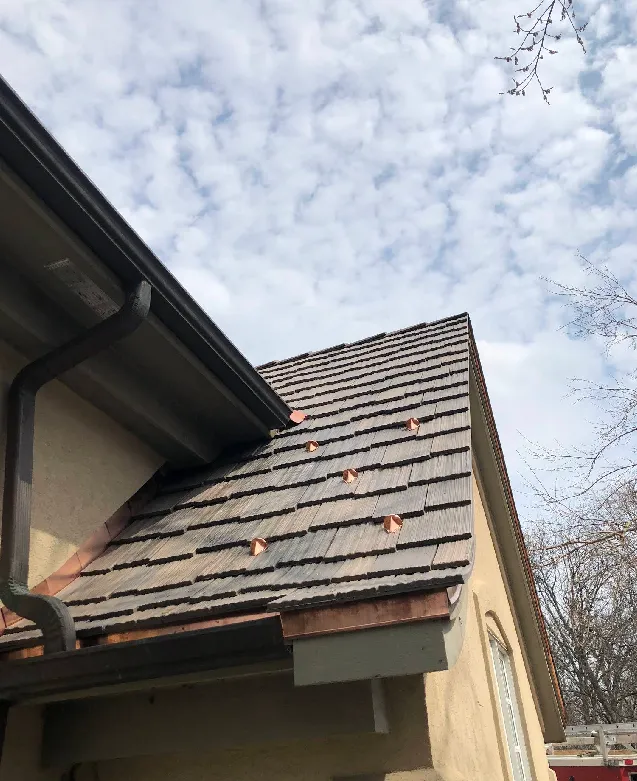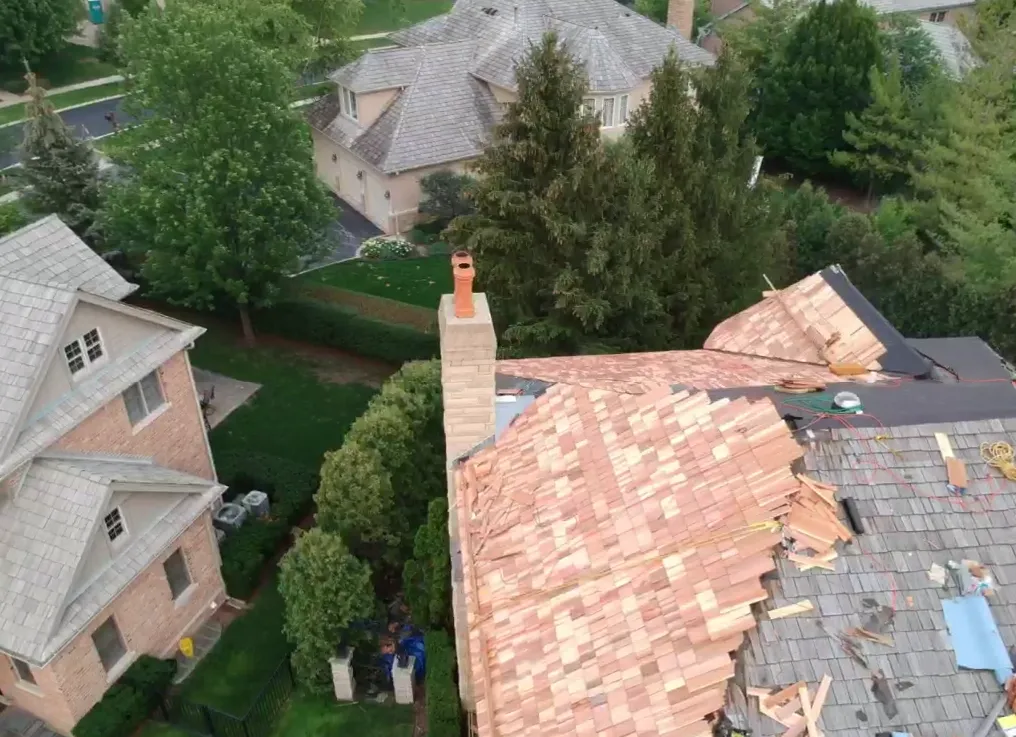
Most homeowners who ask this question have already had at least one repair done. A few shakes were replaced, a valley was reflashed, the leak stopped — and eighteen months later water is coming through somewhere else. At that point the real question is no longer whether the roof can be repaired. It is whether repairing it is still the right decision.
Cedar is unusual among roofing materials in that repair remains genuinely viable deep into the roof’s life. A cedar roof is a system of individually fastened, individually replaceable pieces, and a well-built one can be maintained slope by slope for decades. That flexibility is a real advantage over asphalt. It is also what makes the decision harder, because “can it be repaired?” and “should it be repaired?” have different answers, and the gap between them is where homeowners lose money.
This article covers the seven conditions that move a cedar roof from repair territory into replacement territory, the framework we use to make that call, and the situations where repair is clearly still the correct answer.
The Question Behind the Question
Every repair-or-replace decision on a cedar roof reduces to five factors, in this order:
- Cause. Is the damage from a discrete event (a storm, a failed flashing detail, a fallen limb) or from a systemic condition (no ventilation beneath the shakes, corroded fasteners, chronic moisture)? Discrete causes are repairable. Systemic causes reappear.
- Extent. How much of the roof is affected, and is it confined to identifiable areas or distributed across multiple slopes?
- Deck. Is the sheathing beneath still sound? This is frequently the deciding factor, and it is the one homeowners almost never check before getting estimates.
- Remaining service life. Money spent on a roof that has three years left is money spent twice.
- Economics. At a certain volume of replaced shakes, repair costs approach replacement while delivering none of replacement’s advantages.
The seven signs below are how those five factors present themselves on an actual roof.
Sign 1: Softening Has Spread Beyond Identifiable Areas
The first and most important distinction is between localized decay and distributed decay.
Localized decay looks like this: the bottom two courses above one gutter run are soft, or the shakes within two feet of a chimney are punky, or a single north-facing dormer slope has gone spongy under a tree. Everything else on the roof passes a screwdriver probe. There is a cause you can point to, the cause can be corrected, and the affected shakes can be cut out and woven back in.
Distributed decay looks different: soft shakes appear on three slopes, in the middle of planes rather than at edges, with no single identifiable trigger. That pattern means the wood itself has reached the end of its serviceable condition, not that one detail on the roof failed.
If you are not certain which one you are looking at, the tests are worth doing before you call anyone — the thumbnail test, the screwdriver probe, and the break test are all described in detail in our guide to telling cedar rot apart from normal weathering. Gray cedar is not a reason to replace a roof. Soft cedar across multiple slopes is.
The 30% Rule and Where It Breaks Down
The working rule in cedar roofing is that once roughly 25% to 30% of the shakes on a slope require replacement, repair stops making economic sense for that slope. The labor of selectively removing and weaving in individual shakes across a field is high, the material savings shrink, and you end up with a patchwork of new shakes carrying an old roof.
The rule is useful but incomplete, because it counts only visible failures. On a cedar roof, most of each shake is hidden. An 18-inch shake is typically laid at 7.5 inches of exposure and a 24-inch shake at 10 inches, meaning over half of every shake’s length sits permanently beneath the course above it. The shakes you can see are the part of the roof most likely to still be sound. When the visible failure rate is approaching a third of a slope, the actual condition of the covered wood is almost always worse.
Why Heavy Patching Underperforms on Cedar
There is also a technical reason not to push repair past that threshold, separate from cost.
A new shake is full thickness — typically 1/2 inch at the butt for medium hand-split and resawn, 3/4 inch for heavy. A shake that has been on a Chicago-area roof for twenty-five years has eroded, checked, and cupped. Setting new full-thickness shakes into a field of aged ones creates an uneven plane, and unevenness on a cedar roof means places where water slows down instead of running off.
New shakes also arrive at high moisture content and shrink as they dry to equilibrium. A patch installed tight in spring will have wider keyways by August. Individually that is manageable; across a third of a slope it changes how the roof handles water. And matching grade, thickness, exposure, and cut of the original shakes on an older roof is often not possible at all, because the material specified twenty-five years ago may no longer be produced to the same profile.
Sign 2: The Sheathing Beneath Is No Longer Sound
This is the sign that most reliably ends the conversation, and the one you can check yourself from inside the house.
Once decay has passed through the shakes and into the roof deck, the roof stops being a covering problem and becomes a structural one. Deteriorated sheathing cannot hold fasteners, will not support the weight of a person working on it, and cannot be roofed over — new shakes nailed into soft wood will loosen, and a slope with compromised decking is unsafe to work on at all.
Go into the attic on a bright day with a strong flashlight and everything else switched off, and look for:
- Daylight through the deck anywhere other than intentional vents
- Dark tide lines or staining on the underside of the sheathing, concentrated near valleys, chimneys, skylights, and the eaves
- Sheathing that gives when probed with a screwdriver — the deck should be firm at every point you can reach
- Mold on rafters or sheathing, usually black, gray, or white patching
- A musty, earthy, mushroom-like smell, which is often detectable before anything is visible
- Matted or damp insulation, which indicates water has been arriving for a long time
Isolated deck damage — a few feet of skip sheathing under a failed valley — is a repair. Sheathing that is soft across a slope, or in several separate areas, is not.
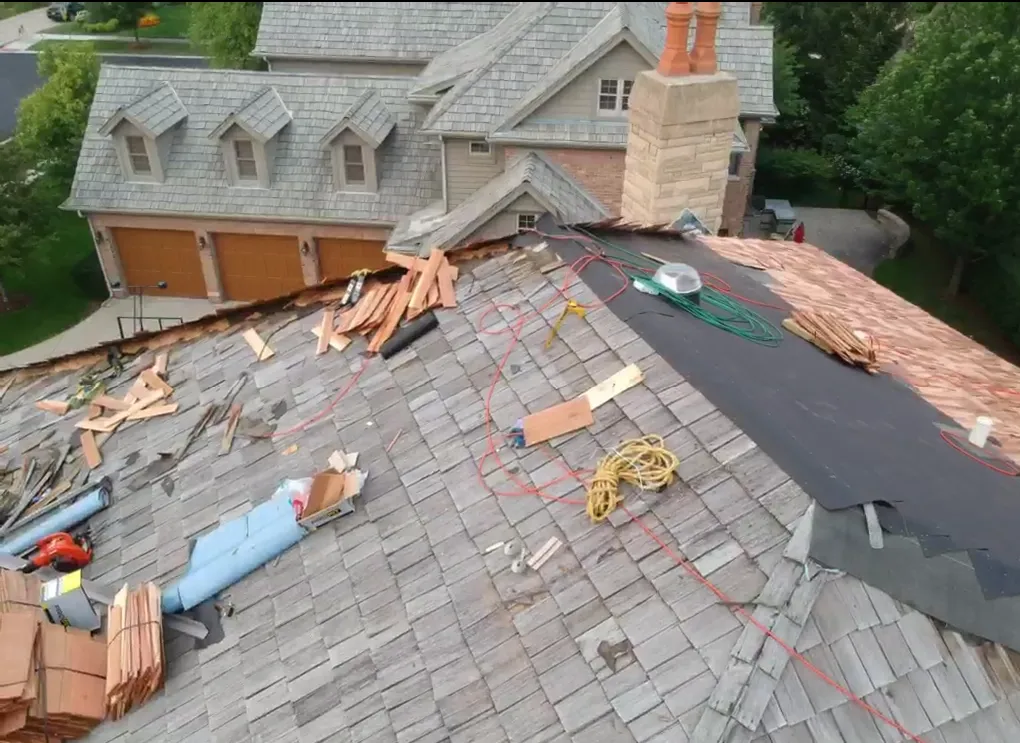
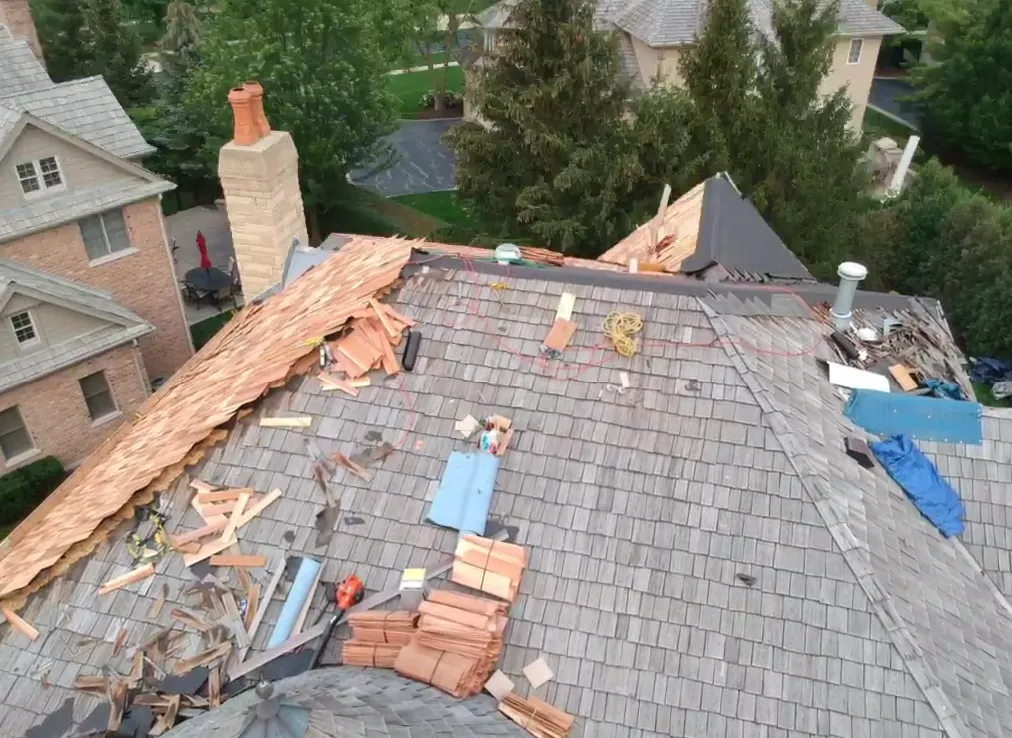
There is a practical corollary here. If the deck needs replacing over any significant area, the shakes above it have to come off to get at it. Once you have opened a slope to the framing, replacing the covering on that slope costs far less as part of the same project than it will as a separate project two years later.
Sign 3: Leaks Keep Appearing in New Locations
One leak is a defect. Three leaks in three unrelated locations within a couple of years is a pattern, and patterns on a cedar roof mean the water management system as a whole is no longer working.
A cedar roof does not resist water by being sealed. It resists water through overlap, spacing, and drainage: three layers of wood over every point of the deck, keyways offset course to course so no gap lines up with the gap above it, and — on shake roofs — an interlayment of felt between courses that carries any water that gets past the wood down and out. When that system is intact, water that penetrates one layer is intercepted by the next.
When leaks start appearing at unrelated points, it usually means one of these has degraded across the roof rather than at one spot:
- Shakes have eroded or split through their thickness, so triple coverage no longer exists
- Keyways have widened past their original spacing as shakes shrank and cupped
- The interlayment felt has deteriorated and no longer carries water out
- Joints between courses have drifted out of offset as shakes shifted
None of those are conditions you fix at the leak. You fix them by rebuilding the system, which means replacement.
Track your service history honestly here. A cedar roof getting a service call every year or two, at a different location each time, is already costing what a planned replacement would cost — just in installments, and with water entering the structure between visits.
Sign 4: Shakes Are Curling and Lifting Across Whole Slopes
Every cedar shake curls slightly at the butt over time, because the exposed portion dries faster than the covered portion. Mild, uniform cupping is ordinary aging and does not compromise a properly overlapped roof.
Severe curling is a different condition, and its significance is in the pattern:
- A few curled shakes scattered across the roof — normal, replace individually if they are lifting enough to catch wind.
- Curling concentrated in one area — usually a local moisture or ventilation problem worth investigating, still repairable.
- Curling across entire slopes, with butts lifted high enough to expose the keyway below — the roof has lost its ability to shed wind-driven rain and it is now vulnerable to uplift. Each storm removes more shakes.
That third pattern is a replacement signal, and it is usually a symptom rather than a cause. Shakes curl severely when they cannot dry from both faces, which brings us to the sign that explains most premature cedar roof failure in the region.
Sign 5: The Roof Was Built Wrong From the Beginning
You cannot repair an installation defect one shake at a time. If the reason the roof is failing is how it was built, every repair is a temporary intervention against a condition that is still fully in place.
Four defects account for the majority of cedar roofs that fail well short of their expected service life.
No Ventilating Layer Beneath the Shakes
A cedar shake has to dry from both faces. This is a material requirement, not a preference. Cedar was historically laid over spaced or “skip” sheathing precisely so air could reach the underside of the wood.
When cedar is installed directly over solid decking and underlayment with no air space, the back of every shake sits against a surface that cannot breathe. Moisture that gets in — through a keyway, from below, from condensation — stays above the moisture content at which decay fungi become active, indefinitely. The roof then deteriorates from the hidden face while the visible surface still looks acceptable. This is why a ventilating mat such as Cedar Breather is installed between underlayment and shakes on modern solid decks, and you can see how we detail it on our own installations in the project gallery.
A roof with no under-shake ventilation will keep failing no matter how many shakes you replace, because the new shakes go into the same non-drying assembly as the old ones.
The Wrong Fasteners
Cedar shakes must be fastened with corrosion-resistant nails — stainless steel, or at minimum hot-dipped galvanized, two nails per shake set roughly three-quarters of an inch in from each edge and just above the exposure line of the course that will cover them.
Electro-galvanized nails, staples, or bright common nails corrode inside wet cedar. The wood’s natural extractives are mildly acidic and accelerate the reaction. As the fastener head deteriorates, the shake loses its hold and slips; as the shank corrodes, it stains the wood around it. A roof shedding shakes with rust-stained nail holes has a fastener failure, and there is no way to address that selectively — the fasteners are inside every shake on the roof.
Wrong Exposure or Missing Interlayment
Shakes laid at too great an exposure for their length do not deliver the triple coverage the system depends on. Shake roofs installed without the felt interlayment between courses have no secondary drainage path. Courses whose joints were not offset sufficiently from the course below create direct channels to the deck.
These are dimensional errors baked into every course. They are not repairable defects.
Over-Nailing and Face-Nailing
Nails driven through the exposed face of a shake, or driven too deep, create entry points and split the wood. Shakes fastened too rigidly cannot move with seasonal moisture change and split as a result. Widespread face-nailing on an older roof is a sign the original work was done by a crew that did not specialize in wood, and it usually comes with the other defects above.
Sign 6: The Flashing Has Failed Everywhere, Not Just Somewhere
Cedar handles the open field of a roof through overlap. It handles valleys, chimneys, skylights, sidewalls, and every other transition through metal.
One failed flashing detail is a straightforward repair: the shakes around it come off, the metal is replaced correctly, the shakes go back. That is normal cedar roof maintenance and it is one of the material’s genuine advantages.
The situation changes when the flashing metal has reached end of life uniformly. Galvanized flashing corrodes, and it corrodes on the same timeline everywhere on the roof, because it all went on the same day. A roof where the valley metal, the chimney flashing, the sidewall flashing, and the skylight curbs are all deteriorating simultaneously requires opening every one of those areas — which is most of the complicated part of a roof. At that point the incremental cost of also replacing the field is small, and the alternative is a series of separate projects, each of which disturbs shakes that are themselves near the end of their life.
This is also the moment to correct the metal specification. Copper and zinc flashing outlast the cedar above them, which means the next roof’s flashing does not need to be revisited. Zinc has the additional benefit of suppressing moss growth on the courses immediately downslope, which matters considerably on shaded North Shore properties.
Sign 7: The Roof Is in the Last Third of Its Life and the Wood Has Lost Its Protection
Western red cedar heartwood contains natural fungicidal extractives — primarily thujaplicins — which are the reason cedar performs as a roofing material without chemical treatment. Those extractives are water-soluble and finite. Decades of rain leach them out of the exposed wood.
This is why decay problems on cedar roofs cluster heavily in the back half of the service life, and why the same repair has a different value at different ages. Replacing shakes on a roof that is a decade old puts new material into wood that still has its own defenses. Replacing shakes on a roof in its final third puts new material into wood that has largely lost them — the surrounding shakes will reach the same condition on their own schedule, regardless of the repair.
Two related factors compound this:
- Grade. Only heartwood carries meaningful extractive content. Roofs built with lower-grade material containing sapwood, flat grain, and defects were always going to have a shorter life, and they reach this stage sooner.
- Maintenance history. A roof that has been cleaned, kept clear of debris, and periodically treated with a preservative has had its protection partially restored along the way. A roof that has never been touched has not.
For how these variables combine over the full life of a roof, see our detailed breakdown of cedar roof life expectancy.
When Repair Is Clearly the Right Answer
The seven signs above describe replacement conditions. They are not the common case. Most cedar roofs we look at are repairable, and a fair number need nothing at all.
Repair — or plain maintenance — is the correct call when:
- The roof has gone gray but the wood is hard. Graying is UV degradation of the top fraction of a millimeter of wood. It is cosmetic. A hard, gray cedar roof needs cleaning and treatment, not replacement.
- Damage is confined to identifiable areas with a correctable cause. One valley, one chimney, the lower courses above one gutter run, a slope under a tree that needs limbing back.
- A storm caused discrete damage to an otherwise sound roof. Wind-lifted or missing shakes and impact damage on a healthy roof are exactly what repair exists for. Storm damage on a cedar roof is also frequently an insurance matter, so document it thoroughly before anything is disturbed.
- The sheathing is sound. A firm deck under a tired covering keeps a great many options open.
- The problem is moss, staining, or debris. Moss does not consume wood. It holds moisture against the surface and creates the conditions for decay, but on hard wood it is a cleaning-and-treatment job. It should never be addressed with a pressure washer, which strips surface fibers and drives water up under the courses.
- One slope is bad and the rest are fine. Partial replacement is a legitimate strategy on cedar, discussed next.
Partial Replacement: The Middle Path
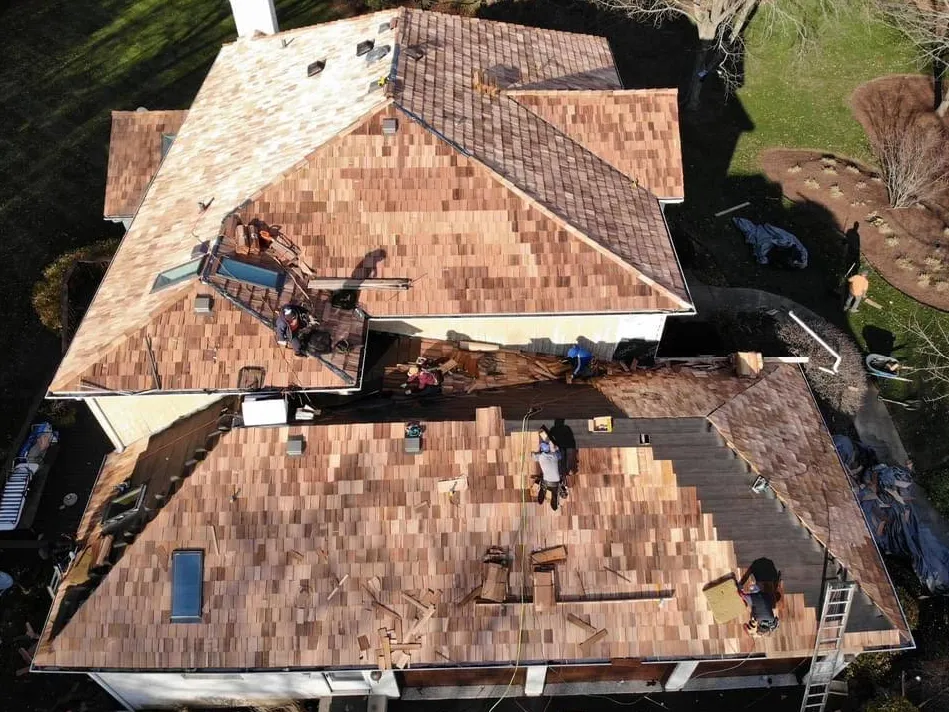
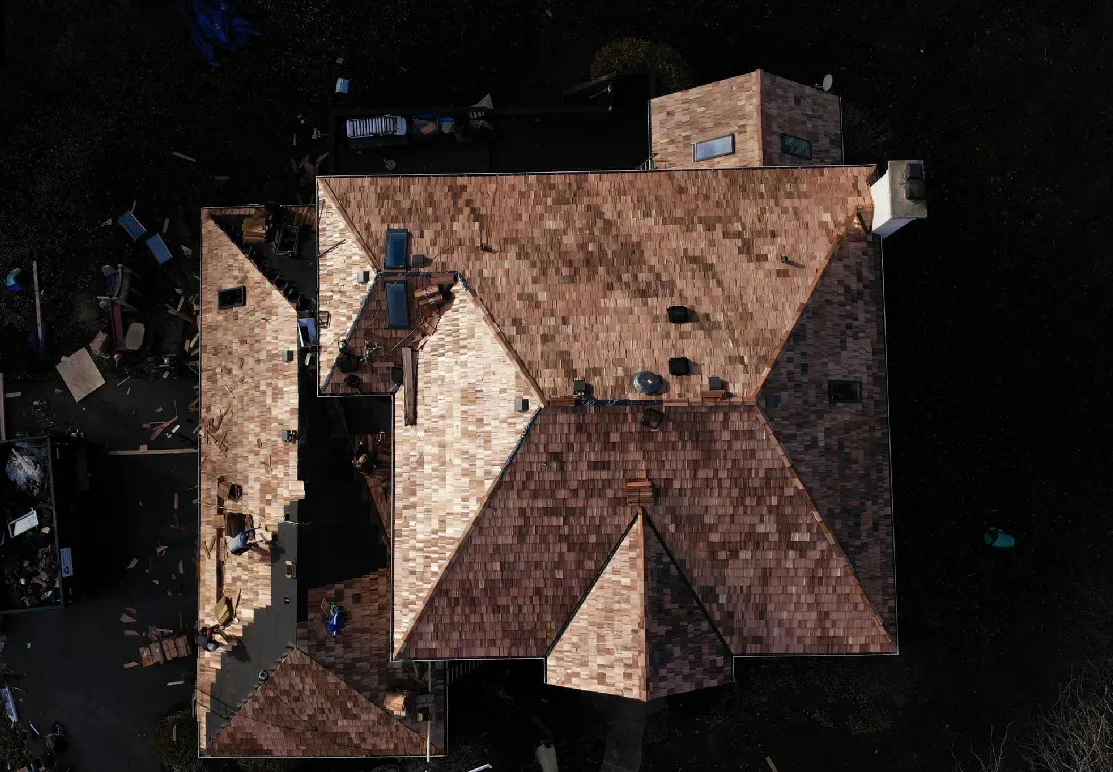
Because cedar roofs weather unevenly by exposure, they often fail unevenly too. A north slope under a mature canopy can be finished while the south slope has years of service left, and replacing a single plane is a recognized approach rather than a compromise.
Partial replacement makes sense when:
- Failure is confined to whole planes rather than scattered across the roof
- The deck under the failing plane is accessible and the balance of the roof is sound
- The remaining slopes have enough life left to justify keeping them
- The failing slope has an identifiable cause that will be corrected in the process
It makes less sense when the roof is close enough to overall end of life that you will be back within a few years for the rest, or when the roof’s problems are systemic — a ventilation defect exists on every plane, not just the one that failed first.
Be aware of the appearance consequence: a newly installed cedar slope will be reddish-brown next to fully silvered slopes, and it takes a few seasons to catch up. On a prominent street-facing elevation that matters, and it is worth deciding deliberately rather than discovering it after the fact. If resale is on the horizon, our post on roof color and resale value covers how buyers actually read this.
Why the Chicago Climate Moves the Line Earlier
The repair-or-replace threshold sits earlier here than national guidance implies, for four reasons specific to the region.
Freeze-thaw cycling. The Chicago area crosses the freezing point dozens of times each winter. Water sitting in a check in a shake expands as it freezes, widening the check; the wider check admits more water next time. Cracks that would stay cosmetic in a milder climate become water entry points here, which means a repaired roof in the region needs the underlying moisture condition genuinely fixed, not just the leak stopped.
Ice dams. Snow melts over a warm attic, refreezes at the cold eave, and holds standing meltwater on the lowest courses of the roof for weeks — the same courses that already handle the most water. Recurring ice dams are the fastest route from a healthy lower course to a decayed one, and they are a symptom of attic ventilation and insulation rather than of the roof covering. Replacing shakes without addressing the dam produces the same failure again.
Tree canopy. The oak and elm cover that defines older neighborhoods in Winnetka, Glencoe, Lake Forest, and Hinsdale extends drying times and fills keyways with organic debris twice a year. Roofs on heavily wooded lots reach the decision point measurably earlier than the same roof on an open lot two streets away.
Hail. Illinois sees enough hail to matter. Impact damage on cedar produces splits and fractured butts rather than the granule loss you see on asphalt, and on an aged roof a single storm can push a marginal covering past the point of repair.
Two Decisions to Get Right Before You Get Estimates
Do not let anyone overlay asphalt on top of cedar. It is occasionally proposed as a cheap way out. Cedar is not a flat substrate, an overlay traps moisture against wood that is already struggling, and the assembly weight and deck requirements are a separate problem. Local requirements on tear-off and layer counts vary by village, so confirm with your municipality before anyone starts — but as a matter of building practice, this is not a shortcut worth taking.
Be skeptical of “restoration” sold on a soft roof. Cleaning, treatment, and selective shake replacement are legitimate and valuable on a roof whose wood is still hard. Marketed as a way to avoid replacing a roof that has already softened through its thickness or lost its deck, the same package is money spent on a delay. The honest version of that offer includes a probe test and an attic look, and sometimes ends with “this one is past it.”
Get an Actual Diagnosis, Not a Guess From the Driveway
The difference between a maintenance visit, a slope replacement, and a full roof is not incremental, and it cannot be determined from a photograph or a walk around the property. It takes probing the shakes, checking the deck from inside, and looking at how the roof was built in the first place.
All Roofs Cedar Shake works exclusively on cedar and shake roofing across Chicago and the surrounding suburbs, including Winnetka, Wilmette, Glencoe, Highland Park, Northbrook, Glenview, Lake Forest, Barrington, Hinsdale, Oak Park, and Naperville. We assess the shakes, probe the sheathing, check what is happening beneath the roof, and tell you which of the three paths you are on — repair, one slope, or the whole roof — including when the answer is that your roof needs nothing.
Call (224) 432-6887 or request a free inspection online. Licensed cedar roofing specialists, Roofing License 104.031891, based at 874 Green Bay Rd, Winnetka, IL.
Frequently Asked Questions
Can a cedar shake roof be repaired, or does the whole roof have to be replaced?
Cedar roofs are genuinely repairable, because shakes are individually fastened and can be cut out and woven back in. Repair is the right choice when damage is confined to identifiable areas with a correctable cause and the wood elsewhere is still hard. Replacement becomes the better option when decay is distributed across multiple slopes, the sheathing has softened, or the roof was built with a defect that affects every course.
How many shakes can be replaced before it makes more sense to replace the roof?
The working rule is that once roughly 25% to 30% of the shakes on a slope need replacing, repair economics no longer favor repair. The rule understates the situation slightly, because more than half of each shake’s length is hidden beneath the course above it, so visible failures generally indicate worse conditions in the covered wood.
Can you replace just one slope of a cedar roof?
Yes, and it is a common approach, because cedar weathers unevenly by exposure. Partial replacement works well when failure is confined to whole planes, the rest of the roof is sound, and the cause on the failing slope will be corrected. The main trade-off is appearance: new shakes will be reddish-brown next to silvered slopes for several seasons.
Does a gray cedar roof need to be replaced?
No. Graying is ultraviolet degradation of roughly the top tenth of a millimeter of wood and has no effect on strength. A hard, gray cedar roof is a maintenance candidate, not a replacement candidate. The test is hardness, not color.
Why does my cedar roof keep leaking in different places after repairs?
Leaks appearing at unrelated points usually indicate that the roof’s water management system has degraded as a whole rather than at one location — shakes eroded past triple coverage, keyways widened beyond original spacing, or deteriorated interlayment felt that no longer carries water out. Those conditions are not fixed at the leak.
Can asphalt shingles be installed over an existing cedar shake roof?
As a matter of building practice this is a poor idea: cedar is not a flat substrate, the overlay traps moisture against wood, and the deck and weight considerations are separate problems. Requirements on tear-off and permitted layers vary by municipality, so confirm with your village before any work is scoped.
Should I repair a cedar roof that is near the end of its service life?
Generally only to buy a defined amount of time. Cedar’s natural fungicidal extractives leach out over decades, so repairs late in a roof’s life put new material into wood that has largely lost its own protection. Targeted repair to get through a season or to a planned replacement date is reasonable; extensive repair at that stage usually is not.